The short answer
Once a year for a bells-only alarm. Twice a year for a monitored alarm or one with police response. That is the industry standard in the UK, and it is what most insurers expect too.
The rest of this guide covers why, what a service actually includes, and the signs your alarm is overdue.
Service intervals by alarm type
| Alarm type | What it does | Service interval |
|---|---|---|
| Bells-only (audible) | Sounds the siren, nothing else | Every 12 months |
| Self-monitored (app alerts) | Siren plus a notification to your phone | Every 12 months |
| Monitored by an alarm receiving centre | Signals to a 24 hour monitoring centre who call keyholders | Every 6 months |
| Monitored with police response | Monitoring centre can pass confirmed alarms to the police | Every 6 months |
These intervals come from BS 9263, the British Standard for maintaining intruder alarms, which sits alongside PD 6662 and BS EN 50131. On modern monitored systems, one of the two yearly checks can often be done remotely. The intervals are the same whatever brand of alarm you have.
Is burglar alarm servicing a legal requirement?
No. There is no law that makes you service an intruder alarm. But there are three reasons it isn't really optional:
- Insurance. If your policy mentions the alarm, read the small print. Many home and most commercial policies require it to be maintained under contract by an approved company. An unserviced alarm can be grounds to reduce or refuse a burglary claim.
- Police response. Systems with a police Unique Reference Number must be maintained to keep it. Too many false alarms in a year and the police withdraw response.
- Noise. A faulty alarm that sounds for hours is a nuisance, and your council can take action over it.
What a burglar alarm service includes
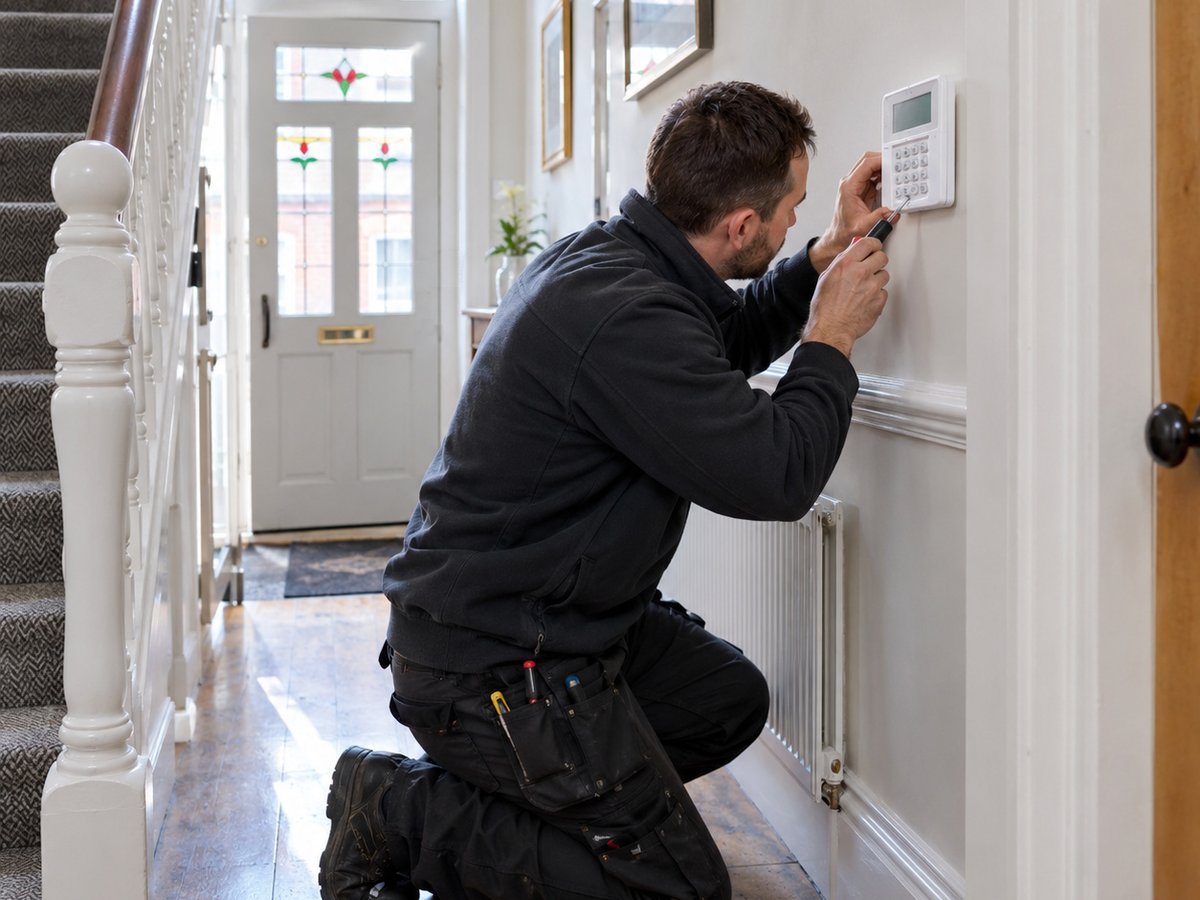
A proper service takes an engineer around an hour for a typical home, longer for commercial premises. It should cover:
- Control panel check, event log review and any fault codes
- Backup battery test, with replacement if it is near the end of its life
- Walk test of every movement sensor
- Door and window contacts, shock sensors and panic buttons
- External sounder and strobe, including its own battery and tamper
- Tamper protection across the whole system
- Signalling test to the monitoring centre or app
- Batteries in wireless sensors, keyfobs and keypads
- Firmware and app updates where the panel supports them
- A quick look at what has changed: an extension, a new pet, furniture now blocking a sensor
You should get a written report at the end, and a note of anything that needs replacing.
Signs your alarm needs a service now
- False alarms, especially at night or in bad weather
- A fault, battery or tamper message on the keypad
- Keypad beeping at random
- The outside bell box doesn't sound or flash on a test
- A sensor that doesn't pick you up when you walk past
- App notifications that arrive late or not at all
- You can't remember the last time anyone looked at it
Old alarms that have sat untouched for ten years often still power up and look fine. The usual failure is the backup battery, which means the system dies the moment a burglar cuts the power.
What you can check yourself
Between services, once a month or so:
- Set the alarm and trigger it on purpose to check the siren works, inside and out. Warn the neighbours, and put a monitored system on test first.
- Walk test each sensor if your panel has the option.
- Look at the bell box. Is it intact, and does the comfort light still flash?
- Make sure everyone who needs the code knows it, and remove codes for people who have moved on.
- Check keyholder details are up to date with your monitoring centre.
This does not replace a service. It just means you find problems sooner.
Home and business alarms
Homes: most are bells-only or app-based, so an annual service is enough. It is worth timing it for early autumn, before the darker evenings when burglaries rise.
Businesses: most commercial insurers ask for a monitored, professionally maintained system. That means six-monthly visits, a maintenance contract and records of each visit. If you also have CCTV or a fire alarm, the visits can often be combined.
Need your alarm serviced in West London?
Ignis Secure is based in Uxbridge and services burglar alarms for homes and businesses across Hillingdon, Hayes, West Drayton, Ruislip, Harrow, Southall, Ealing, Greenford and Hounslow. We work on wired, wireless and hybrid systems, including ones we didn't install. One-off services and annual maintenance contracts are both available, and we offer monitored systems for customers who need police response or an insurer-approved setup.
Get in touch for a clear written quotation, or see our intruder alarms page.
Frequently Asked Questions
How often should a burglar alarm be serviced?
Every 12 months for a bells-only or app-only alarm. Every six months for an alarm that is monitored or has police response.
Is it a legal requirement to service a burglar alarm?
No, but many insurance policies require it, and police response systems must be maintained to keep their response.
How long does a burglar alarm service take?
About an hour for a typical house. Larger homes and commercial premises take longer depending on the number of sensors.
How long do burglar alarm batteries last?
The main panel backup battery usually lasts three to five years. Batteries in wireless sensors typically last around two years.
Can you service an alarm installed by another company?
Usually, yes. We need the engineer code or the ability to reset the panel. If the system is too old to get parts for, we will tell you before doing any work.