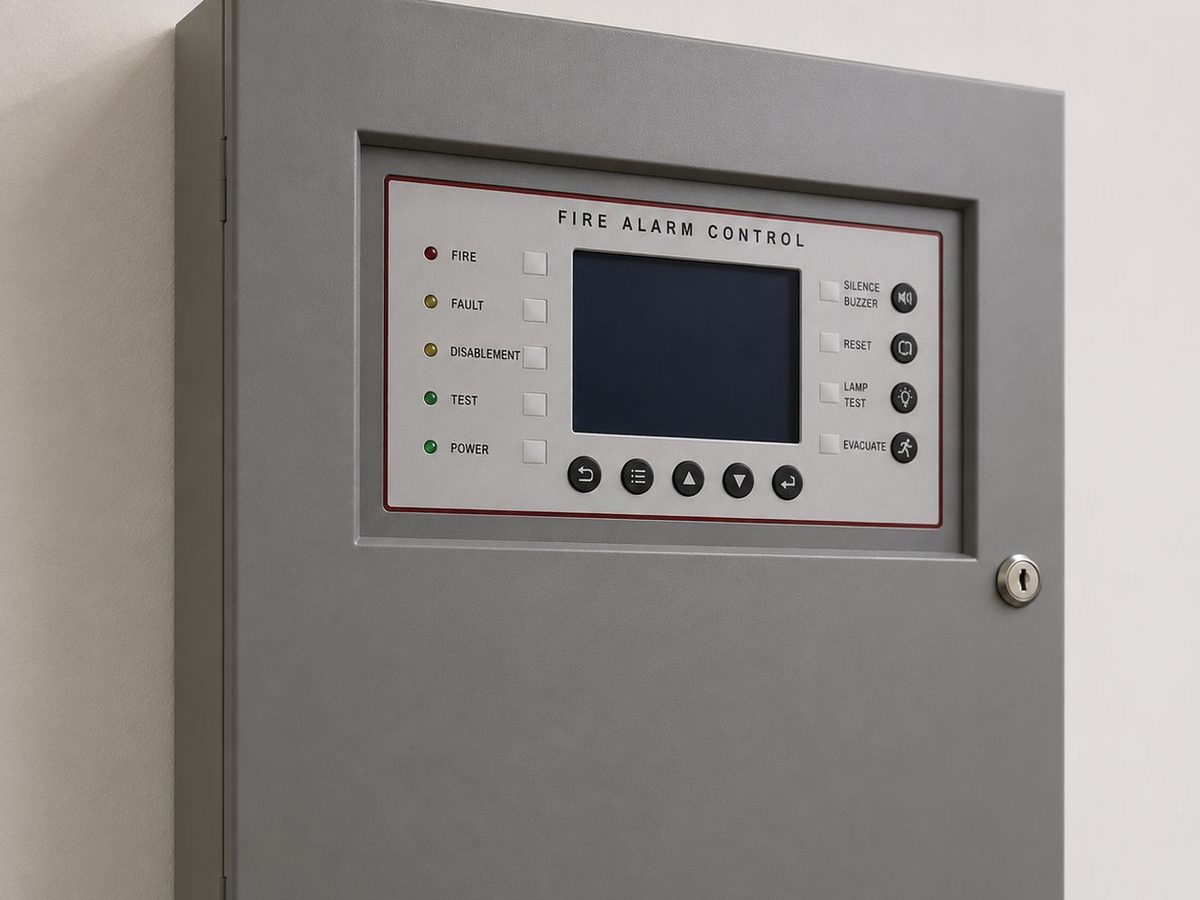
The short answer
In business premises, test the fire alarm every week by operating one manual call point, a different one each time. A competent engineer should inspect and service the whole system every six months, and over each year every detector, call point and sounder should be tested at least once.
That routine comes from BS 5839-1, the British Standard for fire alarm systems in non-domestic buildings. The weekly test is your job. The six-monthly visit is the engineer's. This guide covers the testing side: what to do each week, the extra checks some buildings need, and what to record. For the service visit itself, see our guide to how often a fire alarm should be serviced.
Every building is different. Use this as a general guide, then check your fire risk assessment and any insurer requirements for exactly what applies to your premises.
The testing schedule at a glance
| How often | What is tested | Who does it |
|---|---|---|
| Every week | One manual call point, a different one each week, to check the panel and sounders respond | You or a member of staff you appoint |
| Every month, if some staff miss the weekly test | An extra test at a different time, so night or weekend staff hear the alarm too | You or a member of staff |
| Every month, if fitted | Standby generator started and run on load; vented standby batteries and their connections looked over | You, your staff or your contractor |
| Every six months | Inspection and service of the whole system | A competent fire alarm engineer |
| Every year | Every detector, call point and sounder tested at least once, spread across the service visits | A competent fire alarm engineer |
The current edition of the standard, BS 5839-1:2025, replaced the 2017 version in April 2025. It keeps the six-month service interval but treats a visit made anywhere from five to seven months after the last one as on schedule. That gives some room to plan visits around the business. It is a window, not a reason to stretch every visit to seven months.
How to do the weekly test
The weekly test proves three things: a fire signal can be raised, the control panel picks it up, and the alarm can be heard throughout the building. It also keeps everyone used to the sound. It takes a few minutes.
- Pick a regular slot. Test during normal working hours, at roughly the same time each week, so people recognise it as a test.
- Tell the monitoring centre. If your alarm signals to an alarm receiving centre, call them first and ask for the system to be put on test. Otherwise they may treat it as a real fire.
- Use the next call point on the list. Operate it with the test key. Work through every call point in turn, so each one is tested over time.
- Check the response. The panel should show the correct zone or device, and the sounders should operate across the building. If the alarm is linked to door releases or other equipment, check those work too.
- Keep it short. Let the sounders run for about a minute at most. If a real fire started during the test, people would notice the alarm carrying on.
- Reset and check. Reset the call point and the panel, and make sure the panel is back to normal with no faults showing. If the system is monitored, tell the receiving centre you have finished.
- Write it down. Record the date, the time, which call point you used, the result and your name in the fire alarm logbook.
Number your call points and keep the list with the logbook. Testing the convenient call point by the office every week tells you nothing about the one in the back stairwell that nobody has touched for two years.
If anything fails, write it down and call your maintenance company. Do not wait for the next six-monthly visit.
Monthly checks, where they apply
Staff who miss the weekly test
If some people are never in the building when you test, such as night shifts, cleaners or weekend staff, BS 5839-1 recommends an extra test at least once a month at a time when they are there. Everyone who works in the building should know what the alarm sounds like.
Standby generators and vented batteries
Most small systems use sealed batteries inside the panel, so this does not apply. On larger sites, if an automatically started generator backs up the fire alarm, start it once a month by simulating a mains failure and run it on load for at least an hour. If the system uses vented standby batteries, look over the batteries and their connections each month.
Emergency lighting
Emergency lighting is a separate system with its own standard, BS 5266-1, but its testing fits the same routine. Each month, briefly cut the mains supply to the emergency lights, usually with a test key switch, and check every fitting lights. Once a year, run a full rated duration test, usually three hours, and check every fitting is still lit at the end. Record both in the emergency lighting logbook. Our electrical team installs, tests and repairs emergency lighting.
What gets tested every six months
The six-monthly visit is where an engineer tests the parts of the system you cannot test yourself. Across the visits in each year, every detector, call point and sounder should be tested at least once. A visit typically includes:
- A review of the logbook, including weekly tests, faults and false alarms since the last visit
- Functional tests of detectors, call points and sounders, working through the building so every device is covered within the year
- Checks on the control panel, standby batteries and charger
- Where the alarm signals to a monitoring centre, a check that each type of signal gets through
- A check that the panel clock is right, so the event log shows the correct times
- Checks that linked equipment, such as door releases, still works when the alarm operates
- A certificate and an entry in the logbook
Our guide to fire alarm servicing covers the service visit in more detail, including when quarterly visits make sense.
Keeping the logbook
The logbook is your evidence that testing happens. It can be paper or digital. Keep it on site, near the panel, and record:
- Every weekly test: date, time, call point, result and who did it
- Monthly tests, if your building needs them
- False alarms, with the cause if known
- Faults, and when they were fixed
- Any time part of the system was disabled, and when it was put back
- Service visits, with the certificates kept alongside
- Changes to the system or to the building
A fire risk assessor, an enforcing officer or your insurer will usually ask to see the logbook first. Gaps in it are one of the easiest problems for them to spot.
Who can carry out each test
Weekly and monthly tests can be carried out by the responsible person or someone they appoint, such as an office manager or caretaker. No formal qualification is needed, but that person should be shown how to use the test key, read the panel and reset the system.
The six-monthly service should be carried out by a competent person: someone with the training, experience and equipment to test and maintain fire alarm systems. Fault-finding, repairs and changes to the system are engineer work too. Staff should not disable zones or change panel settings unless they have been shown how, and every disablement should go in the logbook.
What the law says
In England and Wales, the Regulatory Reform (Fire Safety) Order 2005 makes the responsible person accountable for fire safety in non-domestic premises. That is usually the employer, the owner or whoever controls the building. Article 17 requires fire safety equipment to be “subject to a suitable system of maintenance” and “maintained in an efficient state, in efficient working order and in good repair”.
The Order does not say “test weekly” or “service every six months”. Those intervals come from BS 5839-1. But the standard is what fire risk assessors, enforcing authorities and insurers measure you against, so in practice it is the routine you are expected to follow. If your fire risk assessment or your insurer asks for more, follow that.
Common testing mistakes
- Testing the same call point every week. The others are never proven.
- Testing when nobody is in. If no one hears the sounders, you have not checked they can be heard.
- Forgetting the monitoring centre. An unannounced test on a monitored system can be treated as a real fire.
- Letting it ring. A long test teaches people to ignore the alarm.
- Not writing it down. As far as an inspector is concerned, a test that is not in the logbook did not happen.
- Living with a fault light. Silencing the panel buzzer does not fix the fault, and a system showing a fault may not work properly in a fire.
- Leaving zones disabled. Zones are often disabled during building work and then forgotten.
- Treating the service as the test. The six-monthly visit does not replace the weekly test.
Fire alarms in homes
Homes follow a different part of the standard, BS 5839-6. For most homes, with mains-powered smoke and heat alarms, the recommendation is to test every alarm at least once a month using its test button. Panel-based Grade A systems, found in some larger houses and shared buildings, are tested and serviced on a routine closer to a commercial system.
When to call an engineer
Do not wait for the next service if:
- A call point, detector or sounder fails the weekly test
- The panel shows a fault, or a fault keeps coming back after a reset
- You are getting false alarms
- The building has been altered, extended or partitioned, or the way it is used has changed
- There is no record of the system ever being serviced
Fire alarm testing and servicing in West London
Ignis Secure is based in Uxbridge and services fire alarm systems across Hillingdon, Hayes, West Drayton, Ruislip, Harrow, Southall, Ealing, Greenford and Hounslow. We work on wired, wireless and hybrid systems, including ones we didn't install. Every visit ends with a written report, a certificate and an updated logbook, and we set up servicing schedules so visits never fall overdue. We can also show your staff how to carry out the weekly test.
See our fire alarm maintenance page, or get in touch for a clear written quotation. If your system is no longer worth maintaining, we also handle fire alarm installation.
Frequently Asked Questions
How often should fire alarms be tested?
Once a week by you or your staff, using a different manual call point each time. A competent engineer should also inspect and service the system every six months, and every detector, call point and sounder should be tested at least once a year.
Is weekly fire alarm testing a legal requirement?
The law does not set a testing interval. It requires the responsible person to keep fire safety equipment under a suitable system of maintenance. The weekly test comes from BS 5839-1, which is the benchmark fire risk assessors, enforcing authorities and insurers use, so in practice it is expected.
How long should a weekly fire alarm test last?
About a minute at most. That is long enough to check the sounders work throughout the building, and short enough that a real fire during the test would be noticed because the alarm keeps sounding.
Do I have to test every call point every week?
No. Test one call point each week and work through them all in turn, so every call point in the building is tested over time.
What is six-monthly fire alarm testing?
It is the inspection and service by a competent engineer that BS 5839-1 recommends every six months. The 2025 edition allows some leeway: a visit five to seven months after the last one still counts as on time. Across the visits in a year, every device on the system should be tested.
Can I test my own fire alarm?
Yes. The weekly and monthly tests are meant to be carried out by you or your staff. The six-monthly service, repairs and changes to the system should be left to a competent fire alarm engineer.